
Prime Minister Narendra Modi's phone call to Trump will help restore a degree of sanity to Indian statecraft and diplomacy, notes Ambassador M K Bhadrakumar.

Marking a breakthrough in the protracted talks in the French Rafale jet deal, Prime Minister Narendra Modi announced on Friday that India will purchase 36 of these fighter planes that are ready to fly, citing critical operational requirement of the Indian Air Force.
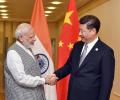
Chinese chief negotiator Ambassador Wang Qun told ANI on Friday, "NSG will not take up India's case as of now. There are differences on admitting non-Nuclear Non-Proliferation Treaty members. Signing the NPT first is one of five criteria (for membership). These have not been set by China, but by group as a whole."

India remains North Korea's 2nd-largest import source after China, according to several estimates by multilateral bodies, says Subhayan Chakraborty.
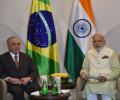
Prime Minister Narendra Modi also thanked Brazilian President Michel Temer for "understanding India's aspiration" for membership of the Nuclear Suppliers Group.
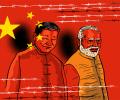
'The government's August 5 decision has impacted India-China relations, but it is not very significant or very different. Things like this have happened in the past.'

'The Senators were playing safe, not angering either the pro-India lobby or the pro-Pakistan lobby, but perhaps more importantly, the military-industrial complex -- the most powerful lobby of all -- which the majority of Senators are beholden to in terms of largesse to their campaign coffers.'

India and the United Kingdom are set to sign a "package of deliverables" during Prime Minister Narendra Modi's first visit here that will also see discussions over cooperation in sectors like nuclear energy and defence.

Talking about the Line of Actual Control, Defence Minister Nirmala Sitharaman said as it is not completely demarcated, there are differing perceptions about it by both sides.

Prime Minister Narendra Modi and United States President Barack Obama will meet on Sunday, January 25, at Hyderabad House a few hours after the American leader's arrival in New Delhi.

Ambassador Natarajan Krishnan and Ambassador Shankar Bajpai helped shape Indian foreign policy at a glorious, but difficult, time in history, recalls Ambassador T P Sreenivasan.
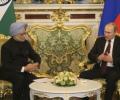
In a clear attempt to allay Russia's apprehensions, Prime Minister Manmohan Singh on Monday said it will remain an "indispensable" partner for India's defence needs even as he underlined that the bilateral ties should adapt to changing times to address challenges.

To persist with talks in the face of continuing terrorism that puts hundreds of Indian lives at stake is not only naive but morally repugnant and ethically unacceptable. It is time to see through this charade and abandon a path of high risk and no returns, says Vivek Gumaste.

The American efforts to make India a security partner have enhanced India's importance to Chinese decision makers and new recognition of India's importance and achievements are reflected in a much more positive reporting about India in the State-controlled media, says Walter Andersen.

India and Japan on Monday agreed to enhance their defence and strategic cooperation to a new level during talks between Prime Minister Narendra Modi and his counterpart Shinzo Abe, who also decided to speed up negotiations on civil nuclear deal that could not be concluded now.
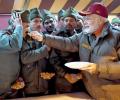
'The BJP has done the Uri surgical strikes, handled the Dokalam crisis and the Balakot strikes.' 'So if there is a de-escalation only at the diplomatic level and not resolving this issue of a colonel being killed, then it translates into public anger.'

This is a national leadership gone so wrong that India's most powerful prime minister in four decades has personally taken charge of medical oxygen shortages, observes Shekhar Gupta.

'Progress demands regular senior-level attention from American leaders.' 'A leaders' summit is great, but we need sustained engagement to continue to forge new agreements and find new areas of cooperation.'

Narendra Modi's positive engagement with Barack Obama has well and truly washed away the doubts and slights of the past.

When asked if the Indian investigating agency would be allowed to visit Pakistan, Basit said that 'the whole investigation is not about reciprocity in view'.
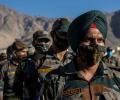
Did Xi deliver a message to Modi at Mamallapuram, which though couched in a velvet glove was time-bound? What was that message? It is clear Indian/Israeli/US spy satellites would not have missed detecting Chinese troop movements towards the Ladakh-Tibet frontier. Then why did some important functionaries in the Government of India choose to only ask the Russians about this in April 2020? Was Russian reassurance of Chinese troop movements being part of a routine exercise the reason that the Leh-based XIV Corps did not mobilise itself for its annual summer exercises near the LAC? A fascinating excerpt from Iqbal Chand Malhotra's new book Red Fear: The China Threat.

The $10.5 billion arms and equipment deal helped to arrest the recent drift in the 'special and privileged' strategic partnership, observes Brigadier Gurmeet Kanwal (retd).

Prime Minister Malcolm Turnbull's first State visit to India is an indication of the success of India's Act East Policy, says Dr Rahul Mishra.
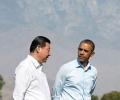
Spread over two days -- Friday and Saturday -- at a picturesque desert resort in Southern California, Obama, 51, and Xi, 59, had several rounds of meetings and a candle-lit dinner spread over nearly eight hours on a range of bilateral, regional and global issues.

'A lack of strategic trust and the 'persistent security dilemma' prevails between India and China,' points out Dr Rup Narayan Das.
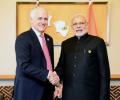
India's efforts to join the grouping suffered a setback in June when the NSG plenary decided against accepting its membership application after China and some other nations opposed entry of a non- Non-Proliferation Treaty signatory.
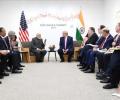
'The change of vocabulary in the India-US conversation was significant and refreshing.' 'It matched the styles of Trump and Modi.' 'The differences were not papered over, but there was determination to resolve them in the days ahead,' says Ambassador T P Sreenivasan.

'I could see it not having any impact whatsoever,' says Stephen P Cohen on Obama's India visit.

'A couple of hours before the H-Hour, the Kupwara division opened small arms and mortar fire on posts opposite its area of operation.' 'This was a diversionary tactic.' 'As Pakistani forces began to react to the firing, special forces teams began to slowly cross the LoC into PoK.' Nitin Gokhale reveals how planning for the surgical strikes began hours after the Uri attack.

The joint statement issued after Prime Minister Narendra Modi and President Barack Obama's first-ever summit is high on intent and ambition. Notably missing from the statement is India's refusal to be America's partner in its war against ISIS.
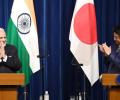
'Relations between India and Japan are robust and devoid of either shadow of history or any irritant.' 'In fact, there is plenty of warmth and goodwill earned over history. There are no negatives but only opportunities,' notes Dr Rajaram Panda.

Both India and South Korea will use President Park Geun-hye's visit to unveil a comprehensive programme for mutual benefit and impacting on regional security environment, says Srikanth Kondapalli.

'Diplomatic engagement will continue even as India keeps all its options open with respect to discretely targeting the Pakistani military and its terrorist proxies.'

'Modi's investment in the relationship with Washington is the biggest deliverable of this visit. He means business and that's fantastic!'

Seoul said North Korea launched the missile apparently to 'provoke' Trump.
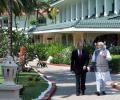
Big ticket defence deals including purchase of missile systems, frigates and joint production of helicopters were sealed on Saturday.

India's doctrinal policy shift in combating terror by carrying out the Balakot air strikes inside Pakistan, appointment of a Chief of Defence Staff and hastening work on military modernisation marked a new beginning in 2019 in dealing with complex security challenges.


'One lesson to emerge out of the Modi-Putin summit is that India can be more self-confident that it possesses inherent strengths to leverage its interlocutors to influence Pakistani policies,' says Ambassador M K Bhadrakumar.

'Even if such a thing happens, it will not prolong for many days like Doklam did.' 'That is because both the leaders do not want it.'
